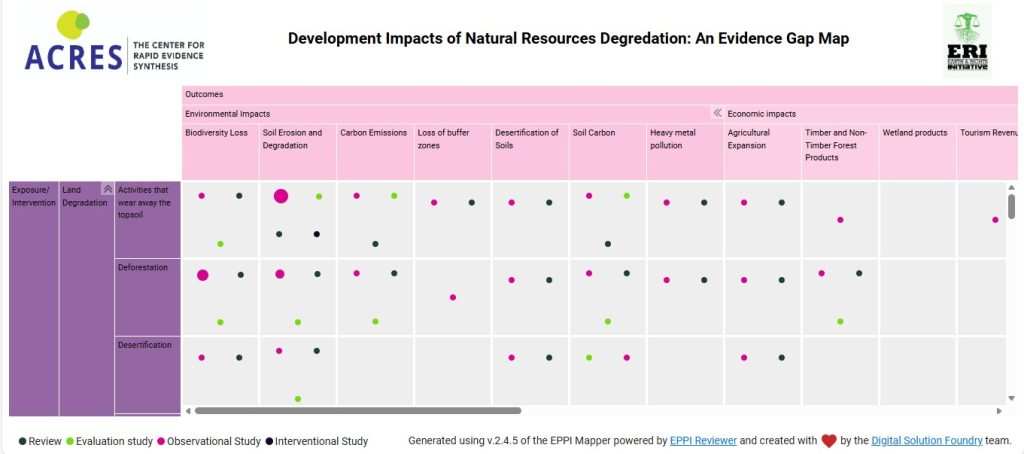
The Center for Rapid Evidence Synthesis (ACRES), in partnership with Earth & Rights Initiatives Uganda (ERI), launch a new interactive Evidence Gap Map (EGM) on the developmental impacts of natural resources degradation.
This tool is designed to empower policymakers, litigators, and advocates with a consolidated evidence base to drive evidence-informed environmental litigation and advocacy, with a particular focus on combating deforestation and wetland encroachment in Uganda.
Funded through the Africa LEEPS project, this initiative directly supports Uganda’s progress toward Sustainable Development Goal 7 (Affordable and Clean Energy) and SDG 13 (Climate Action). The EGM synthesizes research from low- and middle-income countries to clarify the tangible impacts of environmental degradation on communities and economies.
A tool developed through collaboration
The project began with a high-level stakeholder advisory meeting in Kampala, ensuring the map addresses real-world needs. Key contributors included:
- Government agencies (National Environment Management Authority, Ministry of Water and Environment)
- Civil society organizations (environmental advocacy groups, legal aid providers)
- Research institutions specializing in ecological economics
Through this collaborative, co-creation process, stakeholders refined the core research question: “What are the development impacts of natural resources degradation in LMICs?”
What the Evidence Gap Map reveals
ACRES systematically scoped over 2,000 studies to populate the map, which visualizes evidence across three domains:
1. Economic impacts: Livelihood losses, GDP effects, and productivity.
2. Social consequences: Displacement, health issues, and gender disparities.
3. Ecological Outcomes: Biodiversity loss, soil erosion, and climate vulnerabilities.
The interactive map allows users to identify:
- Geospatial patterns of research coverage versus on-the-ground environmental challenges.
- Thematic clusters where evidence is strong or where critical gaps exist.
- Policy-relevant findings that can strengthen legal arguments and advocacy strategies.
Already, the insights from this EGM have proven valuable, informing the drafting of Uganda’s position paper for the COP 30 climate negotiations in Brazil.
Access the tool and explore the evidence
We invite researchers, lawyers, policymakers, and advocates to explore this resource and utilize its findings.
🔍 Access the interactive Evidence Gap Map here: