The Africa LEEPS Partnership
Most international collaborations fail because they are temporary, usually ending when the funding stops. The LEEPS initiative (Learning together to advance Evidence and Equity in Policymaking) is different. As the co-lead of the East Africa Regional Hub, ACRES is connecting the continent’s best minds to ensure that when a leader in Uganda, Ethiopia, or Tanzania faces a crisis in climate or health, they aren’t starting from scratch. The objective is to build a permanent infrastructure for evidence that will outlast any single project.
LEEPS is funded by the Hewlett Foundation, IDRC, and the Robert Bosch Stiftung.
Policy challenges don’t stop at borders, so our solutions shouldn’t either. Through the East African Regional Evidence Synthesis Initiative (EARESI) Hub, we have linked institutions across Uganda (ACRES), Ethiopia (Ethiopian Public Health Institute), Malawi (Malawi-Liverpool-Wellcome Research Programme), and Tanzania (The Centre for Reforms, Innovation, Health Policies and Implementation Research). In managing this hub, ACRES ensures that a breakthrough in renewable energy in Lilongwe, Malawi can quickly inform a policy in Kampala, Uganda. We are replacing a scattered, one-off way of working with a unified front that makes evidence-informed policy a regional standard.
The leadership pipeline
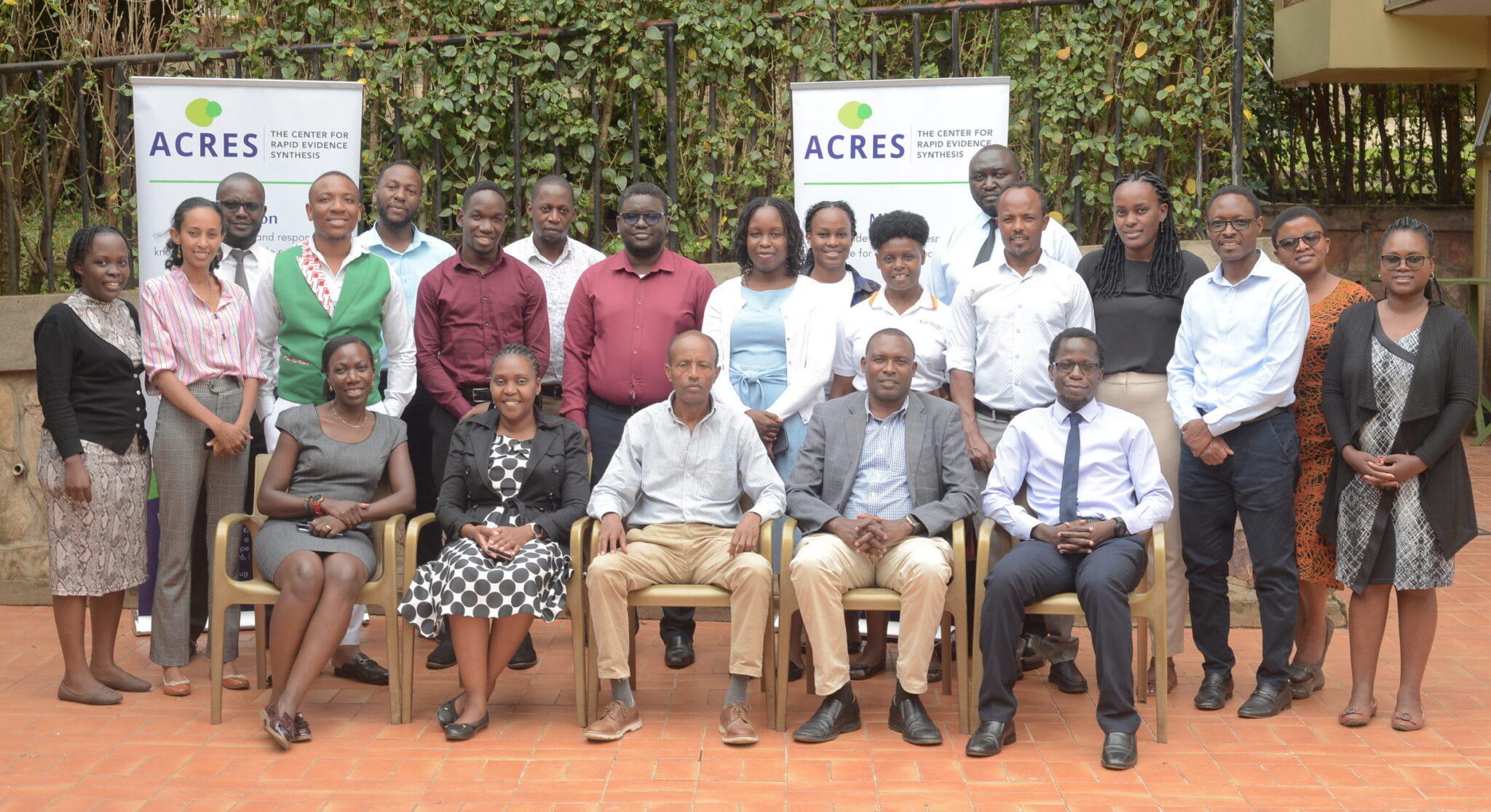
You can have the best data in the world, but it’s useless without someone who knows how to use it. Our Evidence to Policy (E2P) Training Programme is a leadership classroom. We’ve built a tiered system starting from entry-level to advanced that prepares policymakers and researchers to lead their own institutions. These graduates from Uganda, Malawi, Kenya, Ethiopia and Tanzania are already in the field, mentoring their peers and ensuring that an evidence-first mindset becomes a permanent part of the civil service across East Africa.
We believe that evidence should be a public good, not a private secret. To make this real, we’ve built a Digital Evidence Base that is constantly growing by producing over 20 rapid briefs and evidence maps on clean energy, and climate health. We have created interactive tools like Shiny Apps that turn complex data on solar energy or climate health into something a policymaker can engage with and understand in minutes. This makes the evidence compelling and easy to use.
The most sustainable change happens when evidence is built-in to the system. A prime example is our Evidence Service Desk within the National Renewable Energy Platform (NREP) of Uganda’s Ministry of Energy and Mineral Development. We are moving from providing evidence to embedding evidence into daily processes.
The Hub in action
The LEEPS model is already proving its worth across the region:
• Uganda: Our work is directly shaping how the government distributes solar energy and protects natural forests from degradation.
• Ethiopia: The Ministry of Health is using EPHI’s rapid reviews to boost family planning and work toward the 2025 goal of eliminating FGM.
• Malawi: MLW is providing the data needed to bring more women into the clean energy sector and reduce the health risks of biomass cooking.
• Tanzania: Evidence provided by CeRIHI is informing the implementation of the Universal Health Insurance Act, ensuring health coverage for every citizen.
LEEPS focuses on the process, the people, and the permanent structures. We are building the capacity for Africa to answer its own questions for decades to come.